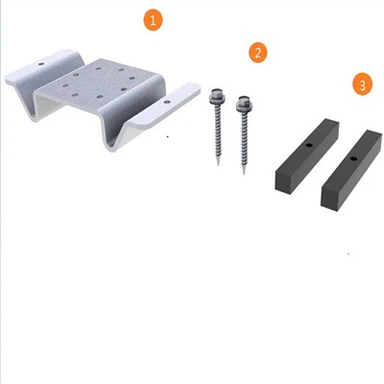




Weighted Solar Mounting Systems
Items:Ballasted Roof Mounting Kits
Material: Aluminum
Tilt angle range: 5/10/15
Max wind load: 40m/s
Max snow load: 2kn/m²
Advantages: Adapting to multiple angles
Lead Time: 7-10 days
OEM: Acceptable
Sample: Available
Supply Capacity: 6MW/week
- Fast Delivery
- Quality Assurance
- 24/7 Customer Service
Product Introduction

who choose us?
Grengy is a well-known manufacturer specializing in the production of photovoltaic brackets, with rich experience and excellent reputation in the photovoltaic field.Our factory is equipped with advanced production equipment and technology. From the selection of raw materials to the manufacturing of finished products, quality is strictly controlled in every step.
one-stop solution
professional team
high quality
For more details, pls email:rukin@grengysolar.com
Weighted solar mounting systems, also known as ballasted systems, have several distinct differences when compared to other solar mounting systems:
1. Installation Method
Non - Penetrative vs. Penetrative
- Weighted Systems: These rely on weights, typically concrete or metal ballasts, to secure the solar panels. They do not require any holes to be drilled, screwed, or nailed into the roof or ground surface. This makes them ideal for rooftops with sensitive membranes, like those on some commercial buildings, as it avoids the risk of leaks.
- Traditional Roof - Mounted Systems: Conventional roof-mounted systems often use anchors, bolts, or screws to attach directly to the roof structure. For example, on a pitched tile roof, installers may drill through tiles and into the underlying rafters to firmly fix the solar panel mounts. This penetration can damage the roof and may lead to water infiltration if not properly sealed.
- Ground - Mounted Systems: Ground-mounted setups usually involve digging holes and using concrete footings or piles to anchor the mounting posts. This is a more invasive process for the ground, but it provides a very stable base, especially for large - scale solar farms.
2. Load - Bearing Considerations
Surface Load vs. Structural Load
- Weighted Systems: Depend entirely on the load - bearing capacity of the surface where they are placed. Since they add significant weight through ballasts, the roof or ground area must be able to support this extra mass. Not all rooftops, especially older or structurally compromised ones, can handle the additional load.
- Structurally - Attached Systems: Traditional roof or ground mounts transfer the load of the solar panels directly to the building's structural elements, such as rafters, beams, or ground foundations. These are designed to carry loads, so in many cases, as long as the structure is sound, they can support larger and heavier solar arrays without relying on additional surface weight.
3. Flexibility
Ease of Reconfiguration
- Weighted Systems: Are relatively more flexible when it comes to repositioning or expanding the solar panel array. Because there are no fixed anchors into the substrate, adding new panels or moving existing ones around is simpler. This is beneficial for scenarios where energy needs change over time or if the initial layout was not optimal.
- Fixed - Mount Systems: Once installed with permanent anchors, fixed - mount systems are more difficult to modify. Altering the position of panels in a traditional roof or ground - mount system may require removing and reinstalling the entire mounting infrastructure, which is time - consuming and costly.
4. Installation Time and Cost
Quick and Simple vs. Complex
- Weighted Systems: Generally have a shorter installation time. Since there's no need for complex anchoring work, such as drilling multiple holes and setting up precise foundations, the setup can be completed more rapidly. This also often leads to lower labor costs, especially for small - to - medium - sized installations.
- Traditional Mounting Systems: Require more time for installation. Roof - mount systems need to ensure proper waterproofing after penetration, and ground - mount systems involve extensive groundwork, both of which add to the overall project duration and cost.
5. Adaptability to Different Surfaces
Flat Surfaces vs. Varied Terrains
- Weighted Systems: Are most suitable for flat surfaces, especially flat rooftops. Their design using ballasts works well in this context, but they may struggle to be effective on sloped or uneven terrains where the weight distribution can become precarious.
- Other Mounting Systems: There are specialized mounts for different terrains. For example, pole - mounted systems can be adjusted for sloped ground, and some roof - mounts are designed specifically for pitched roofs, offering better adaptability to a wider range of installation sites.

Hot Tags: weighted solar mounting systems, suppliers, factory, customized, custom, buy, L Feet