


Dust, Storms Drag Southern European Solar As Central Regions Outperform in March
Apr 12, 2026
March in Europe brought a complex mix of atmospheric conditions for solar, according to analysis using the Solcast API. An early outbreak of Saharan dust temporarily reduced solar resource and caused widespread panel soiling in southern Europe, while much of central and eastern Europe benefited from persistently settled conditions and above‑average solar resource. Late in the month, this favourable pattern broke down as cold polar air and a powerful storm system brought cloud, snow, and damaging winds to many parts of the continent, reducing solar resource once again.
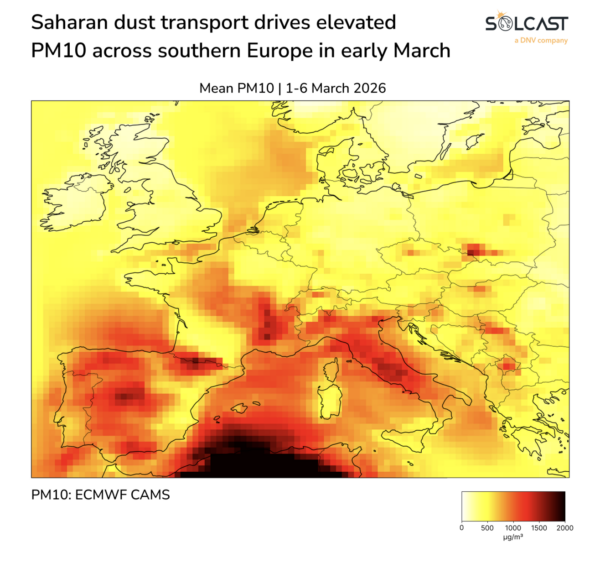
A significant Saharan dust outbreak in early March reduced irradiance across southern Europe while also introducing soiling risks for PV systems. Dust plumes originating over Saharan Africa were transported northwards, reaching Portugal, France and Italy within the first week of the month. This event coincided with the development of windstorm Regina over Portugal, which brought widespread cloud cover and rainfall. The rainy conditions not only further reduced irradiance but also deposited airborne dust onto panel surfaces in the form of "blood rain." This combination of light reduction from atmospheric particles and surface soiling would have temporarily suppressed PV performance across affected regions, with elevated particulate concentrations confirmed by CAMS PM10 estimates during this period.
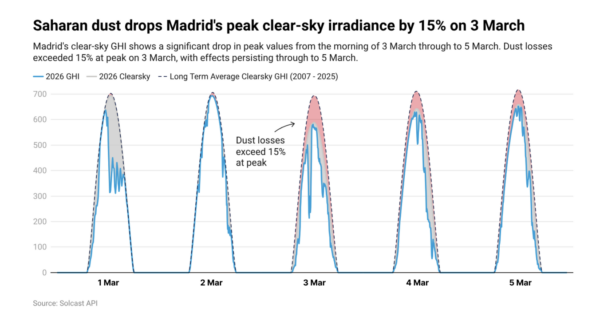
The local impact is visible in Madrid, where Solcast-modelled clear-sky GHI dropped significantly from the morning of 3 March through to 5 March as the Saharan dust plume attenuated sunlight through the atmosphere. Dust losses exceeded 15% at peak irradiance on 3 March, with effects persisting through to 5 March before conditions began to normalize.
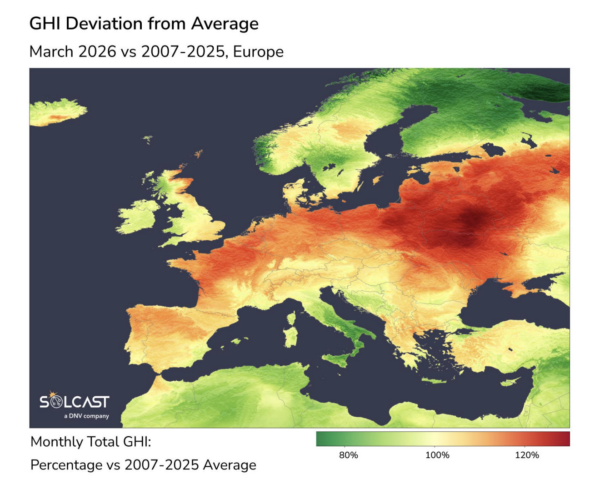
In contrast, central and eastern parts of Europe benefited from sustained periods of clear and settled weather. Prevalent high-pressure systems dominated from northern France through Germany and into Eastern Europe for much of the month. This pattern suppressed cloud formation and enabled irradiance to exceed long-term averages by a notable margin - around 15% in northern France, 10% in Germany, and up to 25% in Poland, with northern Ukraine also seeing gains of approximately 20%. The persistence of this ridge was reinforced by a strongly positive North Atlantic Oscillation, which steered low-pressure systems further north toward Scandinavia, leaving much of continental Europe under clearer skies than typical for March.
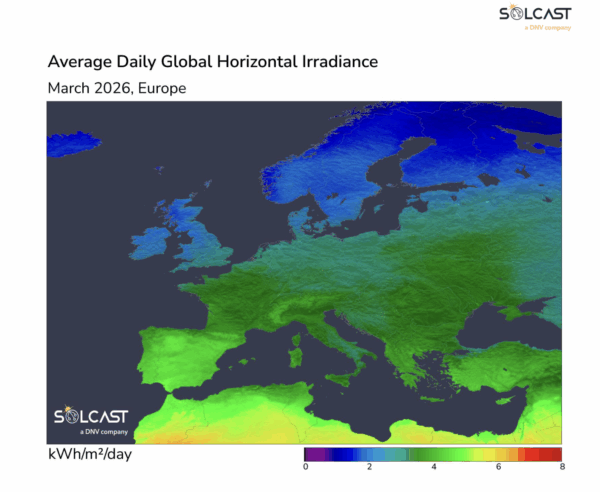
Conditions deteriorated sharply in the final week of the month as a deep trough pushed from the Atlantic into western Europe, drawing in a cold polar airmass. This shift brought widespread cloud, lower temperatures and late-season snowfall, all of which reduced available solar resource and introduced the risk of snow-related soiling. Concurrently, Storm Deborah developed near Italy on 25 March and tracked eastward, producing severe weather across southern and southeastern Europe. Deborah produced hurricane-force winds, heavy rain and thunderstorms across southern and southeastern Europe. Power infrastructure was disrupted, with around 18,000 people in Croatia losing power during the event. Italy, in particular, experienced compounded impacts from both the early-month dust and late-month storm activity, with monthly solar resource in some areas reduced to around 3 kWh/m²/day, well below the long-term average of approximately 3.7 kWh/m²/day. The cold outbreak has been linked to a breakdown of the polar vortex, allowing frigid air to extend into mid-latitudes.
Solcast produces these figures by tracking clouds and aerosols at 1-2km resolution globally, using satellite data and proprietary AI/ML algorithms. This data is used to drive irradiance models, enabling Solcast to calculate irradiance at high resolution, with a typical bias of less than 2%, and also cloud-tracking forecasts. This data is used by more than 350 companies managing over 350 GW of solar assets globally.


