

5 Factors To Consider When Investing in Rooftop Solar Installation
Apr 02, 2022
The vast majority of residential and industrial and commercial photovoltaics install photovoltaic modules on the roof, which can not only help owners save electricity bills, but also optimize the use of roof space and cool the roof.
A few of the most important things to know about installing solar panels on flat roofs.
Any solar mounting solution related question, welcome to consult aria@grengysolar.com!
1: Which installation form will be used?
The methods of installing pv modules on different roofs are also different. Common installation methods include additional type, ballast type and pile foundation type.
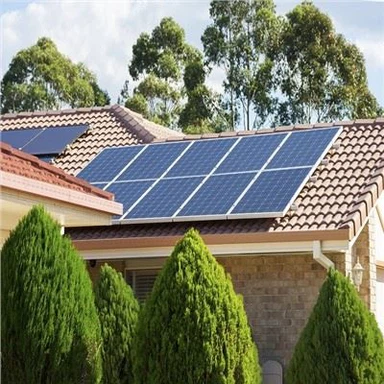
If the roof belongs to the color steel tile type, the additional type is generally considered, and the components are directly tiled on the color steel tile. The tiled type has the best windproof effect and is the safest; in addition, the color steel tile roof also has a certain inclination angle, although it may be It is not the best inclination angle corresponding to solar power generation, but the transformation cost brought by increasing the inclination angle also needs to be considered comprehensively.

For cement roofs, the common installation methods are ballast type and concrete foundation pile type.
Many times, building owners are not allowed to drill holes in concrete flat roofs, on the one hand, they are worried about the strength of the old building, or do not want to change the waterproof performance of the roof. This is why ballast type or concrete foundation installations are chosen.
The ballasted type has no anchorage connection with the roof, so the side can be considered for windproof function.
The main purpose of the concrete base is to ensure that the support system remains intact even during stormy seasons. It ensures a good installation without causing roof leaks, and also increases the efficiency of the solar modules and reduces the shading of the walls from the sun.

2. Installation of flat roof
It seems to be the most natural way to install solar modules on a flat roof. Not only can the installation volume/area be maximized, but it is also possible to use photovoltaics as a roof ceiling to increase the space area.
But in fact, installing solar panels on a flat roof does not mean that you should also set its inclination to 0 degrees, we need to consider many factors, and flat installation should be avoided, including:
The tiled components are easy to accumulate dust, and the accumulation of dust may cause 10% or even 30% of the power generation loss;
It is more inconvenient to clean, and the accumulated water is not easy to flow out;
Compared with inclined installation, the power generation will be reduced;
The payback period will be longer;
May not be able to remove ash deposits by natural rainfall;
There will be obvious differences in the power generation between the inclined installation and the pure tiled photovoltaic array. By simulating a 11.2kWp solar system, the inclination angles are 10 degrees, 5 degrees and 0 degrees respectively.
The simulation results show that if the inclination angle is 0 degrees, the annual power generation of the 11.2kWp system is about 13,480.3kWh, and at a 5 degree inclination angle, the annual power generation of the system reaches 14,066.9kWh. In fact, when the inclination angle is 10 degrees, the annual power generation of the system reaches 14,520kWh.
It can be seen from the results that for every 5 degrees increase, the system increases the power generation by 500kWh per year (after 15 degrees, the increase will be significantly reduced, and it will be lower after exceeding the optimal inclination angle). Moreover, the above simulations have not taken into account the loss of power generation due to fouling during installation at low inclination angles.
According to experts, it is recommended that if you are unwilling to use the best inclination for installation, the installation inclination should be as high as possible. If it must be tiled, it is recommended to design the inclination angle between 5-10 degrees. For flat roofs, an angle of 5-10 degrees is flat enough, while for color steel tile roofs, an angle of more than 3 degrees is generally left. Compared with the additional cost of increasing the inclination angle, let it be , Going with the slope is also a good choice.
3. Flat roof installation must consider maximum wind speed
During the design phase of solar system, the maximum wind speed that may occur locally must be considered, especially in areas with wind speeds exceeding 180 kilometers per hour.
The lifetime of the PV system is 25 years and the maximum wind speed over 50 years must be considered.
Ordinary flat-roof solar power generation systems can withstand a wind speed of 160 km/h (typhoon level 13), but if there is no wall to block the wind, and no wind protection is considered between the arrays, the instantaneous wind speed caused by airflow in local areas will far exceed the actual wind speed. wind speed.
At this time, the selection of brackets, structural design, ballast or concrete foundation strength design must rely on the recommendations of professional institutions, even the tiling of color steel tile roofs, there must be scientific analysis.
Key 4. Leakage risk of flat roof installations
Standing water is common on flat roofs. Since the roof is flat, the water has nowhere to go, or the drainage becomes slower, and the time it stays on the roof will be longer. Therefore, any gaps and holes on the roof will become a place for water to stay.
At this time, the flat roof with the photovoltaic system installed has become the biggest water leakage risk of flat roof photovoltaics due to the damage of the waterproof layer that may be caused when the bracket is installed and the concrete pile foundation is installed.
If it is a color steel tile roof, it is better to use a fixture to install it than to punch holes on the color steel tile; if the color steel tile is not suitable for connecting with a fixture, using structural adhesive is also an option.
5. Equipments on flat roofs need to be considered.
One of the challenges of designing and installing photovoltaics on a concrete flat roof is the various mechanical devices on the roof of the existing building, such as outdoor air conditioning units, drains, exhaust fans, ventilation facilities, water tanks, railings, roof structure, HVAC systems and plumbing, etc.
These existing equipment not only affect the layout of rooftop photovoltaics, but also affect the spacing and arrangement of the brackets, and may also cause shadows to the photovoltaic array, or affect future operation and maintenance.
Some designers will consider installing photovoltaics above these facilities to shield the facilities from wind and rain, but another problem brought by this is the height design requirements and wind protection requirements, as well as the difficulty of operation and maintenance.
For rooftop facilities, the design can only be carried out according to local conditions, but this is an issue that cannot be avoided by rooftop photovoltaics and must be paid attention to.
Any solar mounting solution related question, welcome to consult aria@grengysolar.com!