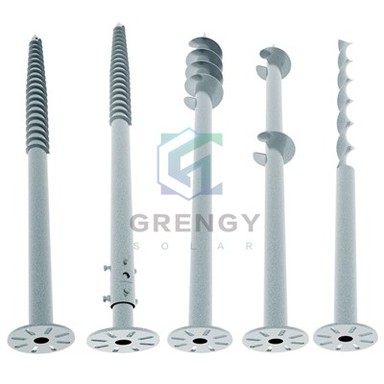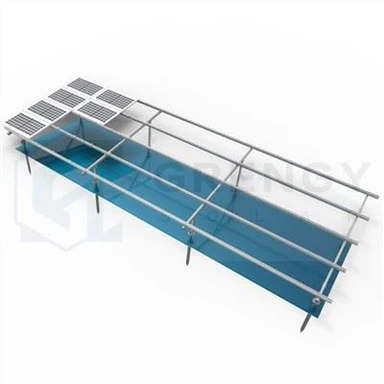




Helical Pile Deck Foundations
Items: Grengy ground screws
Main Material: Hot-galvanized Steel Q235, High Class Hot-galvanized 80μ+
OEM & Sample: Available
Specification: Regular 800-3500mm & Customized/
- Fast Delivery
- Quality Assurance
- 24/7 Customer Service
Product Introduction

who choose us?
Grengy is a well-known manufacturer specializing in the production of photovoltaic brackets, with rich experience and excellent reputation in the photovoltaic field.Our factory is equipped with advanced production equipment and technology. From the selection of raw materials to the manufacturing of finished products, quality is strictly controlled in every step.
one-stop solution
professional team
high quality
For more details, pls email:rukin@grengysolar.com
Producing helical pile deck foundations involves several key steps:
1. Design and Planning
- Load Calculation: Engineers first need to determine the loads that the deck will impose on the foundation. This includes both the dead load (the weight of the deck structure itself, such as the joists, boards, and railing) and the live load (people, furniture, and any other movable items on the deck). By accurately calculating these loads, they can specify the appropriate size and number of helical piles required.
- Soil Investigation: A detailed soil analysis is carried out at the construction site. Core samples are taken to identify the soil type, its density, shear strength, and water content. This information is crucial as it dictates how the helical piles will perform in the ground and helps in finalizing the pile design parameters, like the length, diameter of the shaft, and the helical blade configuration.
2. Material Selection and Preparation
- Steel Selection: High-quality steel is chosen for the helical piles. Commonly, ASTM A572 or A36 steel grades are used due to their good strength-to-weight ratio. The steel is sourced from reliable suppliers and inspected for any defects before use.
- Galvanization: To protect the steel from corrosion, which is especially important since the piles will be buried in the ground and exposed to moisture, the steel components are galvanized. This process involves coating the steel with a layer of zinc, either through hot-dip galvanizing or electro-galvanizing methods. The galvanized finish not only adds durability but also extends the lifespan of the helical piles.
- Cutting and Shaping: The selected steel is cut to the required lengths for the pile shafts. Precision machinery is used to ensure accurate sizing. For the helical blades, thick steel plates are cut and then formed into the characteristic spiral shape. The pitch and diameter of the blades are carefully controlled according to the design specifications.
3. Assembly
- Attaching the Blades: The helical blades are welded onto the central shaft. Skilled welders use appropriate welding techniques, such as arc welding, to create strong, continuous welds. The alignment of the blades around the shaft is meticulously checked to ensure that the pile will rotate smoothly during installation and function optimally in the soil.
- Preparing the Connection Point: At the top of the pile, a connection point is prepared. This could be a flat plate, a bolted flange, or a custom coupling. The connection point is welded or bolted onto the shaft, making sure it is perfectly level and perpendicular to the shaft. This component will later be used to attach the deck's framing members.
4. Quality Control
- Visual Inspection: Each assembled helical pile undergoes a thorough visual inspection. Workers check for any signs of improper welding, cracks in the steel, or misalignment of components. Any defects found are immediately rectified.
- Testing: In some cases, a sample of the helical piles may be subjected to load testing. This involves applying vertical and lateral loads to the pile in a controlled laboratory or on-site testing environment to verify its load-bearing capacity. Torque tests can also be carried out to ensure that the pile can be installed smoothly using the designated equipment.
5. Packaging and Shipping
- Packaging: Once the helical piles pass quality control, they are packaged for shipping. They are typically wrapped in protective materials, such as plastic or heavy-duty paper, to prevent damage during transportation. Bundles of piles may be strapped together for easier handling.
- Shipping: The packaged helical piles are then shipped to the construction site. Depending on the distance and urgency, they may be transported by truck, train, or in some cases, sea freight.

Hot Tags: helical pile deck foundations, suppliers, factory, customized, custom, buy, Screw Pile with Big Blades, Adjustable Screw Pile with Little Blades, Double Pole Mounting System, Non adjustable Screw Pile with Little Blades