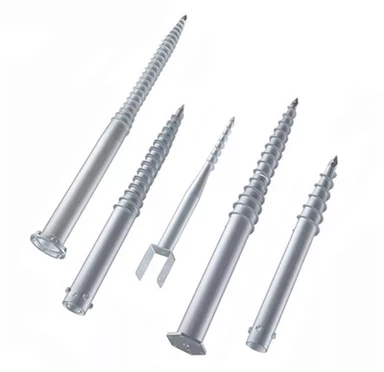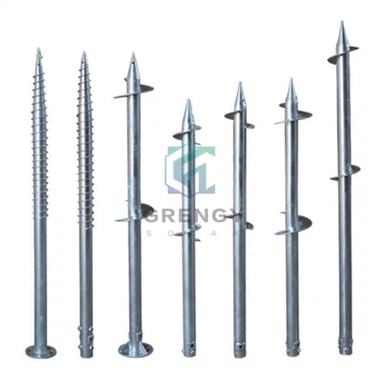




Helical Ground Anchor
Items: Grengy ground screws
Main Material: Hot-galvanized Steel Q235, High Class Hot-galvanized 80μ+
OEM & Sample: Available
Specification: Regular 800-3500mm & Customized
- Fast Delivery
- Quality Assurance
- 24/7 Customer Service
Product Introduction
Xiamen Grengy Photovoltaic Technology Co., Ltd
Founded in 2007. It has a professional R&D team and 150 employees. Specializing in PV products like ground and roof brackets, it offers customized solutions. With business in over 100 countries, it holds multiple patents and certifications such as UL, TUV, CE, being a leading exporter.
Professional team
Our professionals have in-depth knowledge and rich experience in the field of photovoltaic technology, enabling the company to keep up with the international advanced level in product R & D and innovation
Certifications and Standards Compliance
The company's reputation is enhanced by its compliance with a wide range of international and domestic certifications. Having successfully passed UL, TUV, CE, CQC, SAA, AS/NZS1170

1000+
Projects completed
100+
Exported Countries
10GW+
Total Installed Capacity
60+
Patents
For more details,pls email:rukin@grengysolar.com
A helical ground anchor, also known as a helical pile or screw anchor, is a type of deep foundation system. It consists of helically shaped steel plates attached to a central steel shaft with a round or square cross-section. Here is a detailed introduction:
Design and Components
- Central Steel Shaft: The shaft is the main body of the anchor, providing the necessary strength and rigidity to transfer the load from the structure above to the soil. It can be made of different grades of steel depending on the load requirements and environmental conditions.
- Helical Plates: These are the key elements that give the anchor its unique characteristics. The plates are welded or otherwise attached to the shaft at specific intervals and angles. The shape and size of the helical plates, as well as their pitch and number, are designed according to the soil type, load capacity needed, and the specific application. For example, in softer soils, larger and more widely spaced helical plates may be used to provide better bearing capacity, while in harder soils, the plates may be smaller and more closely spaced to aid in penetration.
Installation Process
- Equipment: Specialized equipment is used for installation, such as hydraulic rotary attachments fitted to earth-moving equipment or skid steers with torque motor attachments.
- Rotation and Penetration: The anchor is rotated into the ground using the equipment, similar to screwing in a large screw. The helical plates cut through the soil as the anchor is rotated, allowing it to penetrate to the desired depth. The torque required to drive the anchor in is carefully monitored, and once the predetermined torque value is reached, it indicates that the anchor has achieved the required bearing capacity in the soil.
Advantages
- Minimal Soil Disturbance: Compared to traditional foundation methods that often require extensive excavation, helical ground anchors cause very little disruption to the surrounding soil. This is particularly beneficial in areas where minimizing the impact on existing structures, utilities, or landscaping is important.
- Quick Installation: The installation process is relatively fast, especially when compared to methods like pouring concrete footings or driving traditional piles. In some cases, multiple helical ground anchors can be installed in a single day, depending on the site conditions and the equipment used.
- High Load Capacity: Helical ground anchors are capable of supporting significant loads, both in compression and tension. They can be designed and installed to meet the specific load requirements of a wide range of structures, from small residential buildings to large industrial facilities.
- Adaptability: They can be used in a variety of soil types, including soft clays, sands, gravels, and even some rocky soils with the appropriate equipment and design modifications. Additionally, they can be installed in areas with limited access or in difficult terrain where other foundation methods may not be feasible.
Applications
- Foundation Support: They are commonly used to support new structures, especially in areas with poor soil conditions or where traditional shallow foundations may not be sufficient. They can also be used to underpin existing foundations that have started to settle or need additional support, such as in the case of an old building with foundation problems.
- Retaining Structures: Helical ground anchors are often used to provide lateral support for retaining walls, sheet piles, and other structures that need to resist the pressure of soil or water. By anchoring these structures to the ground, they help prevent them from tipping over or collapsing.
- Temporary Works: In construction projects, helical ground anchors can be used as temporary supports for shoring, scaffolding, or other temporary structures. Their ease of installation and removal makes them a convenient option for such applications.
- Outdoor Structures: They are suitable for anchoring outdoor structures like signs, light poles, and flagpoles, providing stability and resistance to wind and other lateral forces.

Hot Tags: helical ground anchor, suppliers, factory, customized, custom, buy, Screw Pile with Big Blades, Adjustable Screw Pile with Little Blades, Double Pole Mounting System, Non adjustable Screw Pile with Little Blades