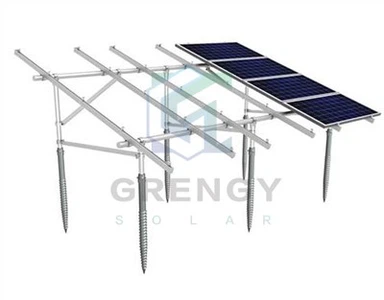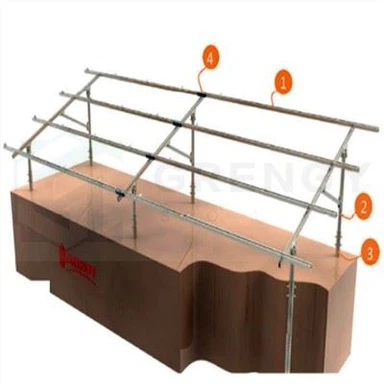




Photovoltaic Ground - Support Structures
Item:Photovoltaic Ground - Support Structures
Tilt Angles:5°-60°
Material:AL6005-T5&SUS304&Q235B
Lead Time: 7-10 days
OEM & Sample: Available
- Fast Delivery
- Quality Assurance
- 24/7 Customer Service
Product Introduction
Xiamen Grengy Photovoltaic Technology Co., Ltd
Founded in 2007. It has a professional R&D team and 150 employees. Specializing in PV products like ground and roof brackets, it offers customized solutions. With business in over 100 countries, it holds multiple patents and certifications such as UL, TUV, CE, being a leading exporter.
Professional team
Our professionals have in-depth knowledge and rich experience in the field of photovoltaic technology, enabling the company to keep up with the international advanced level in product R & D and innovation
Certifications and Standards Compliance
The company's reputation is enhanced by its compliance with a wide range of international and domestic certifications. Having successfully passed UL, TUV, CE, CQC, SAA, AS/NZS1170

1000+
Projects completed
100+
Exported Countries
10GW+
Total Installed Capacity
60+
Patents
For more details,pls email:rukin@grengysolar.com
Here are some common features of Photovoltaic Ground-Support Structures:
1. Durability and Strength
They are typically made of high-quality materials such as aluminum alloy or galvanized steel. These materials can withstand various weather conditions including strong winds, heavy snow loads, and extreme temperatures for a long period. For example, in areas with high wind speeds, the structures are engineered to resist wind forces up to a certain magnitude, ensuring the stability of the photovoltaic panels.
2. Adjustable Tilt Angles
Many ground-support structures allow for the adjustment of the tilt angle of the solar panels. This is crucial as the optimal tilt angle for maximum solar energy capture changes depending on the geographical location and season. For instance, in regions closer to the equator, a shallower tilt angle might be more suitable, while in higher latitudes, a steeper angle is often better. By being able to adjust the tilt, the overall energy generation efficiency of the photovoltaic system can be significantly improved.
3. Easy Installation and Assembly
They are designed with simplicity in mind for quick and straightforward installation. The components usually have pre-drilled holes and standardized connection parts, enabling installers to assemble them on-site with relative ease. Some systems may even come with detailed installation manuals and video tutorials to guide the process, reducing installation time and labor costs.
4. Compatibility with Different Panel Sizes
Ground-support structures are manufactured to be compatible with a wide range of photovoltaic panel sizes and types. Whether it's a standard-sized panel or a more specialized one, the support structure can usually be adjusted or configured to hold them securely. This flexibility allows for the use of various panel technologies and models in a single installation or for upgrades and replacements in the future.
5. Ground Foundation Options
There are different ground foundation methods available. For example, in some cases, concrete footings can be used, which provide a solid and stable base. In other situations, driven piles or helical anchors might be more appropriate, especially in areas with softer soil or where a less invasive installation is required. The choice of foundation depends on factors such as soil type, site topography, and local building codes.
6. Corrosion Resistance
Since they are exposed to the elements, corrosion resistance is a vital feature. Galvanized steel structures have a zinc coating that helps protect against rust and corrosion. Aluminum alloy structures, on the other hand, have inherent corrosion resistance properties. This ensures the long-term integrity of the support structures and reduces the need for frequent maintenance and replacement.
7. Spacing and Layout Flexibility
The design allows for flexible spacing between the support columns and the arrangement of the panels. This is important for optimizing the land use, ensuring proper access for maintenance and cleaning operations, and also for accommodating any site-specific constraints or requirements. For example, in a large-scale solar farm, the layout can be adjusted to fit the shape and topography of the land while maximizing the number of panels installed.

Hot Tags: photovoltaic ground - support structures, suppliers, factory, customized, custom, buy, Single Pole Mounting System, Single Row Solar Mounting System